-2.png)
.jpg)


What Is Land Investing and How Does It Work?
What Is Land Investing?
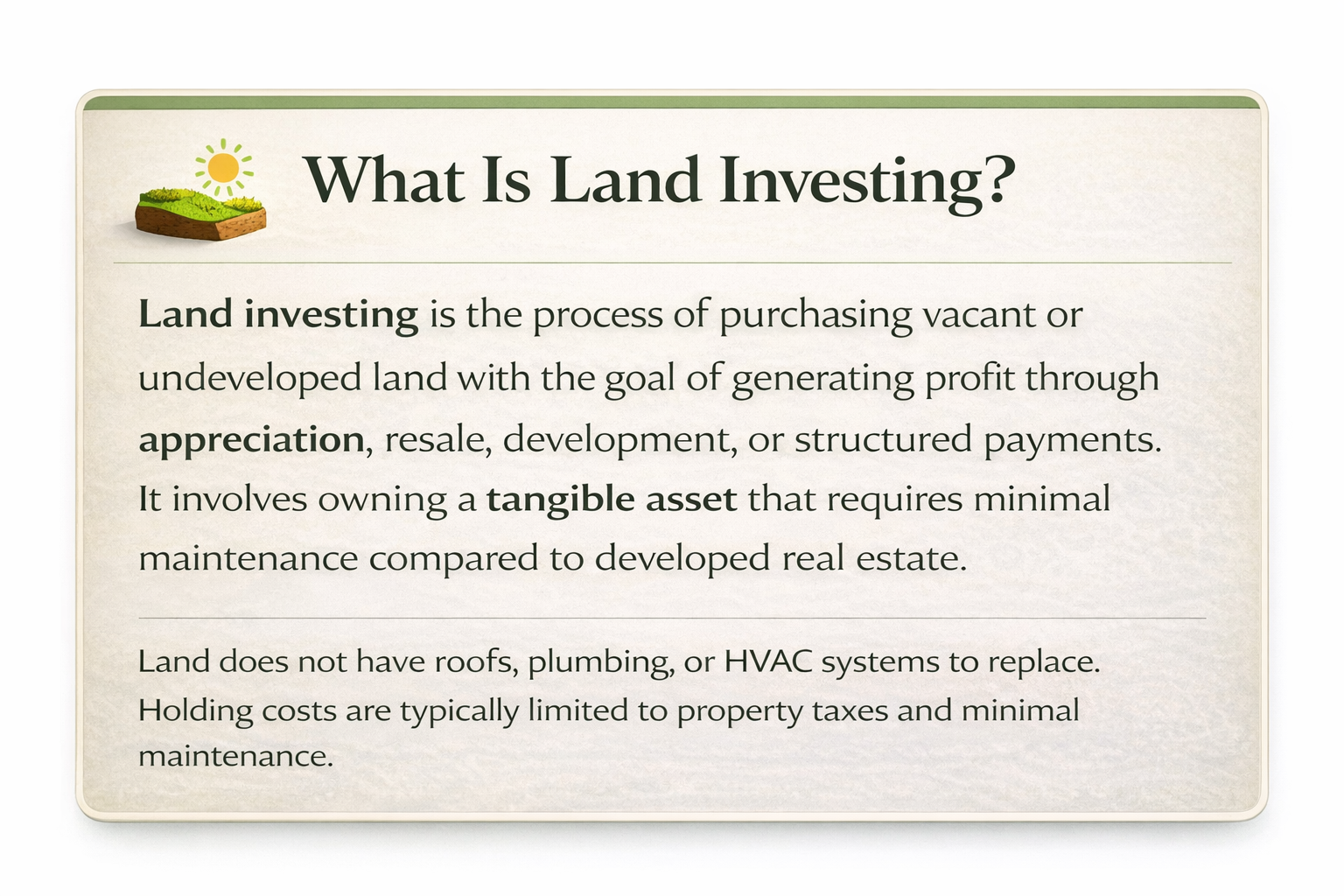
Land investing is the process of purchasing vacant or undeveloped land with the goal of generating profit over time. Unlike residential or commercial real estate that includes buildings, land investing focuses strictly on the raw land itself.
Investors buy land for several reasons. Some hold it long term and wait for appreciation. Others improve it and resell it. Some lease it for farming, recreation, or development. In certain cases, investors generate income through seller financing or land notes.
At its core, land investing is about owning a tangible asset that does not depreciate like vehicles or equipment. Land cannot be destroyed by tenant wear and tear, and it requires far less day-to-day management than rental property.
How Does Land Investing Work?
Land investing works in a few basic steps:
- Purchase land below market value
- Hold, improve, or structure it for resale
- Sell for profit or generate income over time
Unlike house flipping, land typically does not require renovations or repairs. The value is influenced by location, access, zoning, utilities, and development potential.
There are several common strategies investors use.
Types of Land Investment Strategies
Understanding the different ways to invest in land helps determine what approach fits your goals.
1. Buy and Hold for Appreciation
This is the simplest strategy. An investor purchases land in a growing area and holds it until demand increases. As population growth and development expand, land values may rise.
This strategy works best in areas near expanding cities, infrastructure projects, or desirable recreational regions.
2. Land Flipping
Land flipping involves purchasing land at a discount and reselling it quickly at a higher price. This may involve clearing title issues, improving access, or simply marketing the property better.
Flipping focuses on margin and speed rather than long-term holding.
3. Land Development
Some investors improve land by adding utilities, roads, or subdividing it into smaller parcels. Development requires more capital and planning but can significantly increase value.
4. Seller Financing and Land Notes
Another strategy involves selling land using seller financing. Instead of receiving full payment upfront, the investor receives monthly payments from the buyer.
This creates predictable income over time. These payments are often secured by the land itself, reducing risk compared to unsecured investments.
Why Investors Choose Land
Land investing has unique advantages compared to other investment types.
Key benefits include:
- No tenants to manage
- Lower maintenance requirements
- No property repairs
- Tangible, physical asset
- Potential for appreciation
- Flexible exit strategies
Land does not have roofs, plumbing, or HVAC systems to replace. Holding costs are typically limited to property taxes and minimal maintenance.

Risks of Land Investing
Like all investments, land carries risk.
Potential risks include:
- Slower appreciation in certain markets
- Limited liquidity compared to stocks
- Zoning or access restrictions
- Market downturns
Proper research reduces many of these risks. Understanding local growth trends, zoning laws, and comparable sales is essential before purchasing.
How Beginners Can Start Investing in Land
Getting started with land investing does not require millions of dollars. Many rural or recreational parcels are affordable compared to developed property.
Beginner steps include:
- Researching growth areas
- Understanding zoning and land use
- Reviewing access and utility availability
- Comparing recent land sales
- Starting with smaller, lower-risk parcels
Some investors choose to begin with seller-financed land or invest in land-backed notes to generate income without directly managing property.
Land Investing vs Other Investments
Land investing differs from stocks, rental properties, and businesses.
Compared to rental real estate:
- No tenants
- Fewer ongoing expenses
- Less management
Compared to stocks:
- Physical, tangible asset
- Less volatility day to day
- No dependence on corporate performance
Each investment type serves a different purpose. Many investors include land as part of a diversified portfolio.
Is Land Investing Right for You?
Land investing may be a good fit if you:
- Prefer tangible assets
- Want lower maintenance investments
- Are comfortable with long-term holds
- Want flexible income strategies
It may not be ideal for investors seeking immediate liquidity or rapid short-term returns.
Final Thoughts
Land investing is the practice of purchasing raw or vacant land to generate profit through appreciation, resale, development, or structured payments. It offers flexibility, lower maintenance compared to rental properties, and the security of owning a physical asset.
For investors seeking simplicity and long-term potential, land can be a practical addition to an investment portfolio.
Disclaimer: This blog post is purley informational. Please do your own research.
Securities Disclaimer: The information on this site is for informational purposes only and does not constitute an offer to sell or a solicitation of an offer to buy any securities. Any such offer may be made only to verified accredited investors and only by Mountains West Ranches, LLC (“MWR”) pursuant to the Private Placement Memorandum, Subscription Agreement, and related documents (collectively, the “Offering Documents”). Securities offered under Regulation D, Rule 506(c) are not registered with the SEC or any state securities regulator and are offered in reliance on exemptions from registration. No governmental agency has passed upon the merits of any offering or the adequacy of the Offering Documents. Investing involves substantial risks, including loss of principal, illiquidity, limited transferability, prepayment/default risk, subordination (if applicable), and potential conflicts of interest. Past performance is not indicative of future results. Any projections or forward-looking statements are inherently uncertain and actual results may differ materially. MWR is not a bank, investment adviser, or tax adviser. Investors should consult their own financial, legal, and tax advisers. Offers may be limited by state Blue Sky laws. Access to offering materials requires accredited-investor verification.

Explore our latest blogs & insights for inspiration
Stay Updated on New Notes
Stay informed as new land notes become available. We release a limited number of notes as they are created, each backed by real Utah land with clearly defined terms. By staying updated, you can review opportunities early, compare options, and invest when a note aligns with your goals and timeline.